
Anxiety Aid International registered as a Scottish charity in June 2026. When I first met its founder in August, there was no website, no funding and no delivery history.
There was, though, a very clear idea of how the charity should work. This is the story of turning that into a site.
Why this site was different
This site had to do more than look good.
It will be read by people having a hard time, often late at night, often on a phone, sometimes before they have told anyone. A slow page means someone closes the tab. A long form means someone decides not to ask for help.
Does this still work for a frightened person at two in the morning?
Every decision started with that one question.
How it came together
An introduction
South Ayrshire Council put me in touch with Alan Currie, the charity's Founder and Chair. Before our first meeting, I did some legwork for him: a guide to the funds that genuinely apply to a brand new mental health charity in South Ayrshire, and what needed charity registration in place first.
The first meeting
Alan came prepared. He handed me a written brief and a detailed framework setting out how the charity works: CARE, which stands for Connect, Acknowledge, Restore, Empower, and six support pathways from the lightest to the most involved.
That made all the difference. I was not guessing what the charity did. It was written down.
The right information, fast
Over the following days Alan sent approved public wording, the charity's logos and colour palette, and a full website brief. Each one answered a question before I had to ask it.
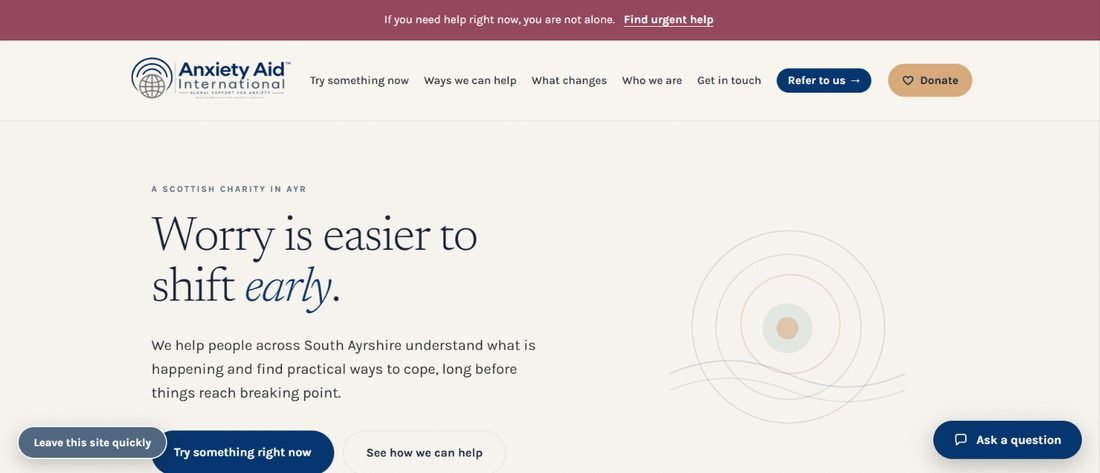
I turned it into a working demo: the six pathways, simple wellbeing tools, an assistant, and crisis help on every page. Alan reviewed it, pushed back where it mattered, and the design settled quickly.
The real build
The demo became a custom WordPress site on the charity's own domain, with its own email. Alongside it, the Ask AAI assistant, anonymous measurement, a partner and referral tool, and an automated safety test suite.
I also removed something. The demo had an example case study that looked good. It could not be evidenced, so it came out. Alan agreed straight away.
Governance, not an afterthought
The trustees approved the privacy notice. Alan and I put in writing who owns what, so the charity owns its content and data outright and could keep operating if the arrangement ever changed.
Looking further ahead
Alan set out the charity's long-term direction. Between us, Alan and I agreed what is already built, what foundations go in now, and what waits until funding is in place. The site grows in stages rather than all at once.
Live, and tested properly
The site went online before it launched. Alan audited it himself, testing the full contact journey, the safety responses and everyday questions end to end.
I would rather launch a week later than launch something that has not been checked by the person who knows the charity best.
Launched
The charity launched publicly, starting in South Ayrshire. The foundations were in: the pages people need first, the assistant, crisis help, measurement and the governance behind it all.
The first new piece: donations
The first addition after launch was a way to give. There is now a Donate button on every page, a fundraising page, and one-off and monthly gifts.
Payments are handled by Stripe, so card details never touch the charity's site. Donors see a proper thank-you page afterwards, and Alan updates the fundraising total himself.
Growing in stages
From here the site grows as the charity grows, with each new piece planned and agreed before it starts. That keeps it steady for the people using it, and affordable for a charity at the very start of its journey.
What is in place
What it does
- Six support pathways, lightest first, so nobody is pushed towards the most involved
- Wellbeing tools anyone can use in seconds, with no account
- Crisis help built into every page and into the assistant
- A simple route for GPs and link workers to refer
- One-off and monthly donations, handled securely by Stripe
- Plain English throughout, built to WCAG 2.2 AA
What it deliberately does not do
- Store anything a person types into a tool
- Follow anyone between visits
- Use tracking cookies
- Promise results or timescales
- Publish anything the charity cannot evidence
The part nobody sees
The Ask AAI assistant looks like a small box in the corner of the page. It is deliberately not connected to a language model, so it can only give answers the charity has written and approved.
Crisis wording is checked before anything else runs, and every helpline number is fixed in the code rather than generated. The safety suite tests it against thousands of messages, including misspellings, Scots and messages where the worrying part is buried in an ordinary question.
The safety report also says what the testing does not prove. A clean result is not the same as a safe system, and real messages will always find gaps a test set does not. I think saying so is part of doing it properly.
Knowing whether it helps
A new charity has nothing to show a funder yet. So the site counts what people actually do: which tools get used, which pathways get chosen, and whether the assistant was opened.
After someone finishes a tool, they can tap once to say whether it helped just now: yes, a little, or not yet. It is optional, anonymous and only ever asked afterwards. Only daily totals are kept, so there is no record of any individual visit.
Now the site is live, that gives the charity real evidence of need to take to funders, rather than a promise.
In Alan's words
From our very first meeting, Colin understood that Anxiety Aid International needed much more than simply a website. It had to be clear, accessible, safe and genuinely useful to someone who may be struggling with anxiety at that moment. What he has built with us has gone far beyond what I originally imagined. His commitment, creativity, technical knowledge and attention to detail have been exceptional throughout. He’s not simply developed a website; he’s helped us establish the foundations of something with the potential to make a real difference to people’s lives.
What I took from it
The quality of this site comes down to the quality of what I was given. Alan knew how his charity should work, wrote it down, and answered questions quickly. That let me spend my time on the things that matter most: safety, clarity and honesty.
If you run a small charity, that is the best preparation you can do before you speak to anyone about a website.
Building something that has to work when it matters?
I build websites and digital tools for charities and community organisations, at rates they can actually afford.
📅 Book a 15-Min Call ✉ Email me
I am Colin Rodgers, founder of Thinking ForWord Social CIC in Ayr.
colin.rodgers@thinkingforwordsocial.com
Thinking ForWord Social CIC, company number SC881418, Alloway House, 6 Alloway Place, Ayr, KA7 2AA.
Published with the permission of Anxiety Aid International, Scottish Charity SC055392.